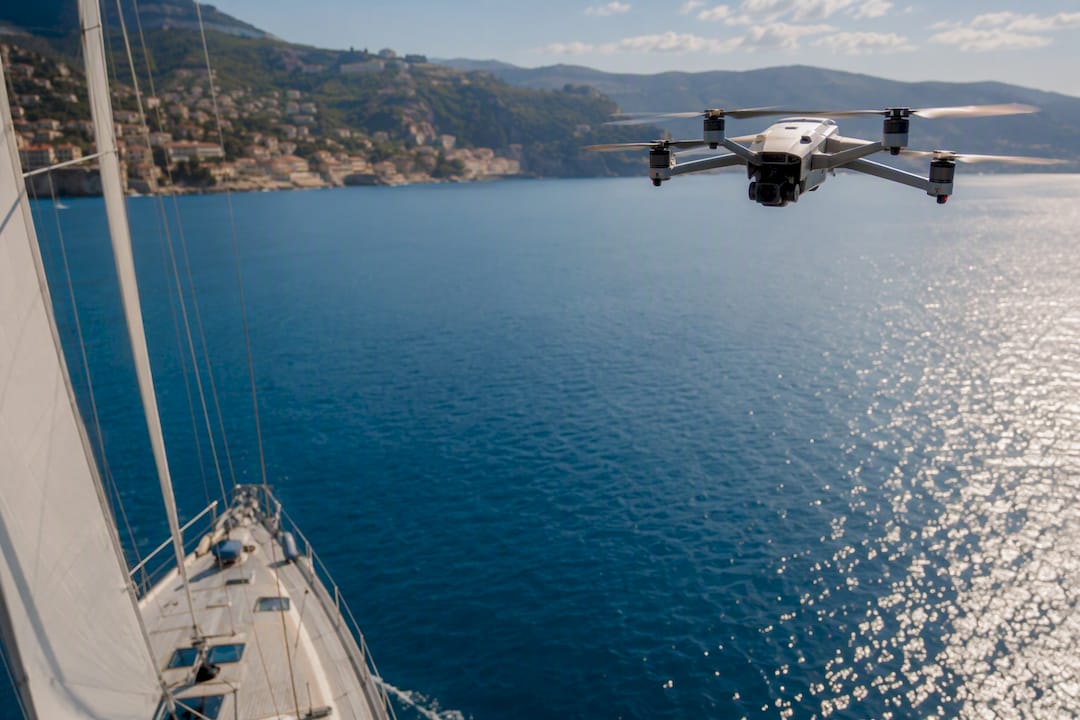
Yes, flying a drone on your yacht charter is usually fine, but it always comes down to two things: local airspace rules and your captain’s say-so. Before you even unpack the controller, run through this:
- Ask the captain first. Always. It’s their vessel and their call.
- Check local drone regulations and any no-fly zones for your route.
- Plan your battery and return-to-home (RTH) settings before takeoff.
The biggest risks aren’t the drone itself. They’re a moving yacht confusing the RTH system and a captain who says no because nobody asked.
Principalele concluzii
A safe drone flight on a yacht charter depends on captain approval, a properly managed home point and RTH setting, and a battery return threshold of 35 to 40 percent.
| Punct | Detalii |
|---|---|
| Get the captain’s approval | The captain has final authority over onboard drone use and can refuse it outright. |
| Manage RTH before launch | Set the home point to the controller or disable RTH so the drone doesn’t chase a boat that’s moved. |
| Bring it home early | Return the drone at 35 to 40 percent battery to leave a safety margin for recovery. |
| Hand-catch with backup | Use a spotter and gloves, and clear the deck before any hand-catch recovery attempt. |
| Coordinate footage in advance | Agree on speed, heading, and standoff distance with the skipper before filming begins. |
Cuprins
- Drone On Yacht Charter Rules: What The Law And The Captain Say
- Why Flying Over Water Is Riskier Than Flying Over Land
- Your Preflight Checklist Before Launching From The Deck
- Flying And Recovering Safely Once You’re Airborne
- Getting Great Footage Without Ruining The Moment
- How Sailarmada Helps You Plan A Drone-Friendly Charter
- Where To Check Regulations And Get Help
- What Most Advice Gets Wrong About Drones And Yachts
- Sources
Drone On Yacht Charter Rules: What The Law And The Captain Say
Drone laws don’t pause at the harbor. Most countries follow frameworks similar to the European Union Aviation Safety Agency’s rules, which restrict flights near airports, military installations, and protected coastlines regardless of whether you’re standing on land or a swim platform. If your itinerary passes near a busy port or a national marine park, assume there’s a restriction until you’ve confirmed otherwise using a local aviation app or NOTAM lookup.
Then there’s the human factor. The captain carries legal responsibility for everyone’s safety onboard, which means they can veto a drone flight outright, and they usually have good reasons when they do. A cluttered anchorage, gusty conditions, or guests uncomfortable with a buzzing quadcopter overhead are all valid grounds for a “not right now.”
Charter operators are often relaxed about casual drone footage over open water, but that flexibility tends to disappear in crowded marinas or tight anchorages where other boats and swimmers are nearby. That’s also where privacy matters most: filming another private vessel or the people aboard it without consent can cause real friction, so keep your lens pointed at your own charter, not your neighbor’s deck.
- Confirm airspace status before departure, not after you’ve launched.
- Treat the captain’s decision as final, even if the conditions look fine to you.
- Never film other yachts, marinas, or bystanders without clear permission.
Understanding these dynamics is part of why coordinating with your crew early matters so much, something covered in more depth in our guide on essential skills for yacht charter.
Why Flying Over Water Is Riskier Than Flying Over Land
Water changes how a drone behaves. GPS signals can suffer from multipath interference bouncing off the surface, and compasses sometimes drift when there’s no strong magnetic reference nearby, which is why professionals calibrate the IMU and compass on land before ever launching from a moving deck.
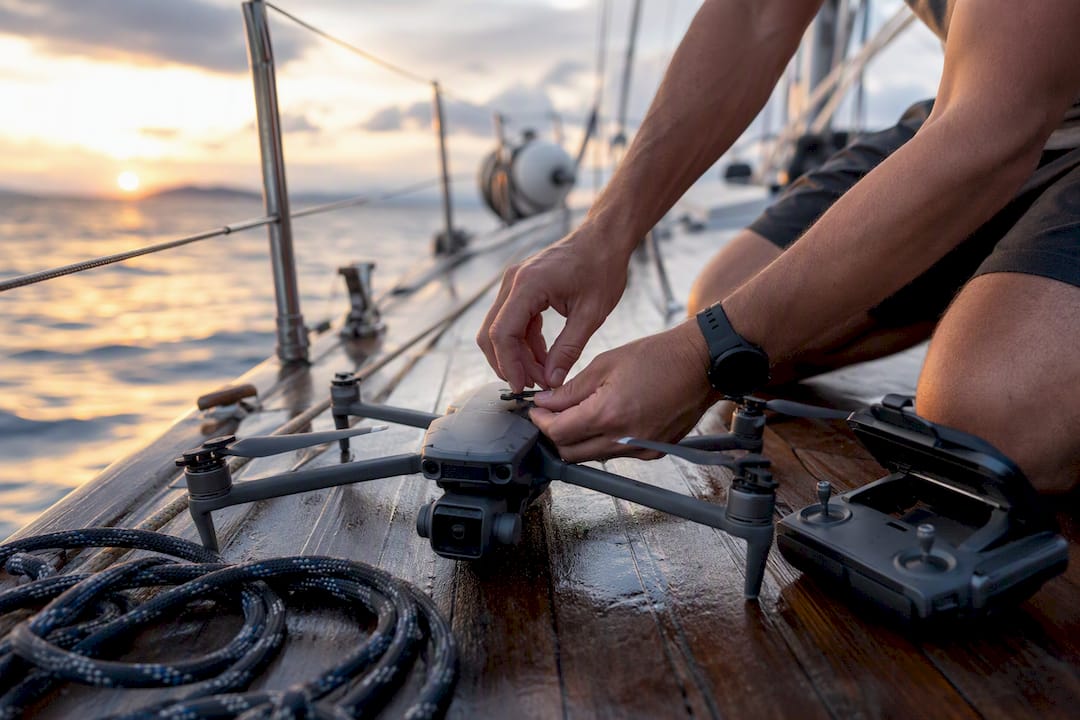
The bigger issue is RTH. Your drone’s default return point is wherever you launched it. A yacht that’s cruising or drifting means that point is now open water. Setting the home point to the remote controller instead of the original launch spot, or disabling automatic RTH entirely, prevents your drone from flying itself into the wake behind you.
Wind at sea also behaves differently than wind on land. Gusts funnel around a yacht’s superstructure and can hit harder than the forecast suggests, so conservative limits matter more here than almost anywhere else.
- Calibrate compass and IMU on solid ground, not on a rocking deck.
- Set a dynamic home point tied to the controller, or disable RTH.
- Keep wind limits conservative, especially if you’re still building experience.
- Rinse and dry your drone after every sea flight to fight salt corrosion.
Sfat profesional: Salt spray finds its way into seams you didn’t know existed. Wipe down the drone, gimbal, and controller with a damp microfiber cloth, then let everything air dry completely before repacking it.
Your Preflight Checklist Before Launching From The Deck
Run this sequence every time, not just the first time:
- Get the captain’s explicit go-ahead and tell the rest of the crew what you’re planning.
- Check local airspace restrictions with a regulator app or NOTAM search for your exact coordinates.
- Set the home point to the controller or a fixed dock reference, and turn off or reconfigure automatic RTH.
- Plan your battery: bring the drone home at 35 to 40 percent charge, and pack a spare if you have one.
- Inspect propellers, arms, and seals for salt residue or hairline cracks from the last flight.
- Assign a spotter to handle recovery and clear the launch zone of loose gear, lines, and antennas.
- Calibrate the compass and IMU on land or on a stable dock, never on a rocking deck.
Sfat profesional: Write the battery percentage rule on a piece of tape and stick it to your controller. In the excitement of chasing a shot, it’s easy to forget you’re at 20 percent until the low battery alarm starts screaming.
Flying And Recovering Safely Once You’re Airborne
Launch into the wind and climb quickly to clear the yacht’s rigging and superstructure. Keep the drone within visual line of sight the entire flight, and skip sport or aggressive flight modes anywhere near guests, swimmers, or the boat itself.
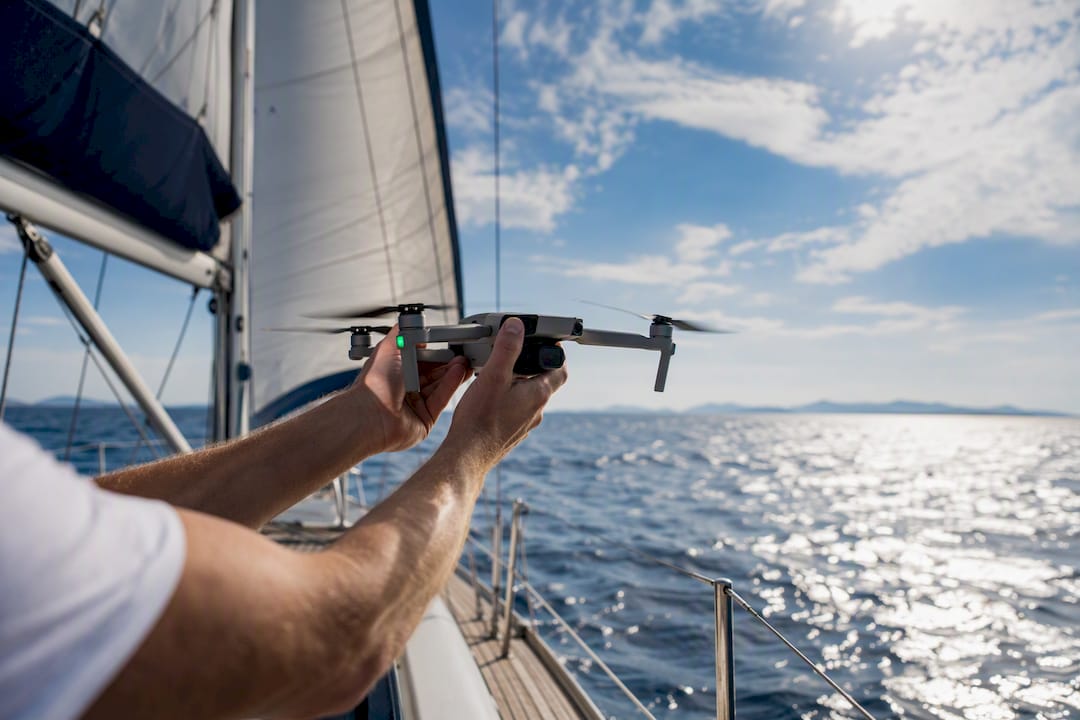
If you lose signal, a failsafe set to hover is safer than an automatic return, since auto-return can send the drone straight into water that’s no longer under the launch point. Instead, calmly reposition the yacht toward the drone’s last known location and re-establish control.
Hand-catching is the standard recovery method for many charter flights, but it’s not casual. Use a dedicated spotter, wear thin protective gloves, and clear the recovery zone of lines, antennas, and anything else that could catch a propeller.
- Launch into the wind and gain altitude fast to clear the boat.
- Set failsafe to hover, not auto-land, when flying near a moving vessel.
- Hand-catch only with a spotter, gloves, and a cleared deck.
- Call off the flight if wind, glare, or crowding makes the shot unsafe.
Sfat profesional: If the shot matters more than the risk you’re comfortable taking, hire a professional operator instead of pushing your own limits. A missing drone ends the fun faster than a missed shot ever will.
Getting Great Footage Without Ruining The Moment
Set your exposure, frame rate, and ND filter before takeoff so you’re not fumbling with menus mid-flight. Golden hour, the hour after sunrise or before sunset, gives you warmer light and longer shadows that make hull lines and wake patterns pop on camera.
Talk to the skipper before you fly. Agree on speed, heading, and a safe standoff distance so nobody’s surprised when the boat turns or accelerates mid-shot. Smooth orbit and follow modes look more cinematic than sport mode anyway, and they’re a lot less likely to startle guests near the rigging.
- Pre-set camera settings on land, not while hovering over water.
- Shoot during golden hour for richer color and softer shadows.
- Coordinate heading and speed with the skipper before every flight.
- Use gentle orbit or follow modes rather than aggressive sport settings.
If you’d rather leave the technical side to someone else, this practical guide to drone photography from yachts walks through gear and shot planning in more depth.
How Sailarmada Helps You Plan A Drone-Friendly Charter
Flag your drone plans when you book, not once you’re already aboard. Telling Sailarmada ahead of time lets us build it into the itinerary, coordinate with the skipper, and check whether permits or notifications are needed for your route.
Some charter operators bring crew-operated drone services or can point you toward vetted local aerial photographers, which sidesteps the whole “am I even allowed to fly this” question entirely. Professional Greek-based videographers who work directly with yacht crews also handle the post-flight cleaning and maintenance that keeps gear corrosion-free between charters.
Advance coordination is what separates a charter where the drone adds to the trip from one where it becomes the trip’s biggest headache.
Planning ahead also protects other guests’ privacy and keeps your itinerary running smoothly instead of stalling for a mid-week permission negotiation. If you’re weighing your options for a private charter that can accommodate this kind of request, our private sailing page is a good place to start the conversation.
Where To Check Regulations And Get Help
For airspace rules, check your national aviation authority’s app or NOTAM system before departure. For recovery technique, the Pilot Institute’s boat-flying guide is worth bookmarking. To plan a charter that accommodates your filming plans, visit Sailarmada.
What Most Advice Gets Wrong About Drones And Yachts
Most guides treat drone flights over water as a camera problem. It’s actually a coordination problem, and that distinction changes how you should prepare.
The conventional advice focuses heavily on shot composition and camera settings, which matter, but they’re not where charters actually go wrong. They go wrong when nobody talked to the captain first, or when the RTH system tries to return the drone to a spot the yacht left twenty minutes ago. Those two failures account for most of the lost-drone stories you’ll hear at any marina bar.
If you take one thing from all of this, prioritize the boring parts first: get explicit permission, fix your home point, and set a battery threshold you’ll actually respect. The cinematic orbit shot can wait until those fundamentals are locked in. A charter with a skipper who trusts your process, and a drone that comes home reliably, beats a stunning single clip that costs you the rest of the trip’s goodwill.
- Sail
Sources
- How to drone from a boat — Christine Lozada
- 15 tips on flying a drone from a boat — Pilot Institute
- Fly a drone and land on board a yacht — Yachting World