The moment you spot the Greek coastline, three things matter most: have your passports, boat registration, insurance, and crew list ready; pay the TEPAI fee through the eTEPAI portal if your vessel qualifies; and get your Transit Log stamped by the Port Authority and Customs before you drop anchor anywhere else. Sort these first and the rest of your check-in falls into place.
TL;DR:
- Smaller ports like Corfu and Leros typically handle check-ins faster, but peak season in July and August can cause longer waits and delays.
- Having all documents digitized and ready, including payment screenshots and stamped crew lists, significantly reduces check-in time and frustration.
- The TEPAI fee for vessels over 7 meters is due before or on entry, with an option for annual payment if the boat exceeds 12 meters, but online portal issues may require in-person payment.
- A valid Transit Log with proof of VAT or Union status, such as an MRN or T2L, is increasingly enforced and crucial for longer stays or returning to Greek waters.
- Prior planning for environmental and anchoring restrictions helps avoid issues during inspection, especially around protected zones where discharging waste or anchoring is prohibited.
Table of Contents
- Quick checklist: documents, receipts and tech to have before arrival
- Step-by-step check-in flow at a Greek port: where to go and in what order
- TEPAI / eTEPAI: how the recreational fee works and how to pay it
- Transit Log and proof of VAT / Union status: expectations and practical evidence
- Common problems and practical avoidance strategies
- SailArmada’s on-the-water checklist and handover priorities
- Health and safety checks or COVID-19 related entry requirements
- Environmental regulations and inspections during check-in
- Rules for customs clearance related to personal belongings and provisions on board
- Specific regulations regarding charter yachts vs privately owned yachts
- Information on quarantine rules if applicable
- Information on registering your yacht’s local mooring or anchorage permissions
- First-person perspective: why a fast, correct check-in protects your trip
- How SailArmada can simplify arrival and charter logistics in Greece
- FAQ
- Sources
Quick checklist: documents, receipts and tech to have before arrival
Before you reach the dock, gather everything into one folder, physical and digital. Greek port officials move through this paperwork fast when it is complete, and slowly when it is not.
- Original passports for every person on board, plus photocopies.
- Boat registration certificate and radio license.
- Original insurance certificate, ideally with Greek-language coverage amounts or a certified translation.
- A printed and digital crew list signed by the captain.
- Your eTEPAI e-Paravolo receipt or confirmation that you can pay on arrival, plus your MRN or T2L if you already hold one.
- A charged laptop or phone with a power bank, a saved map of the port authority and customs office locations, and local contact numbers for the harbor master.
Digitize everything before you leave your home port. A scanned folder on your phone has saved more than one skipper from a frustrating wait when an original document was left in a drawer back home.
Step-by-step check-in flow at a Greek port: where to go and in what order
Greek check-in follows a predictable sequence, though the pace depends heavily on the port. Call ahead when you can. Many smaller port authorities keep limited hours, and confirming them in advance avoids arriving to a locked office.
- Port Authority first. Hand over your crew list for a dated stamp. This stamp is your starting point for everything that follows and proves your date of entry.
- Customs and Immigration next. Officers stamp passports, confirm or initiate your Transit Log, and check your TEPAI payment status if your boat falls under the fee.
- Complete the online Transit Log. Submit through the official portal once you have your stamped crew list in hand. If the system shows approval as pending, keep your printed submission as proof you applied on time.
- Return to the Port Authority with your customs-stamped documents to finalize the process. Keep that stamped crew list safe. You will need it again at checkout and during any at-sea inspection.
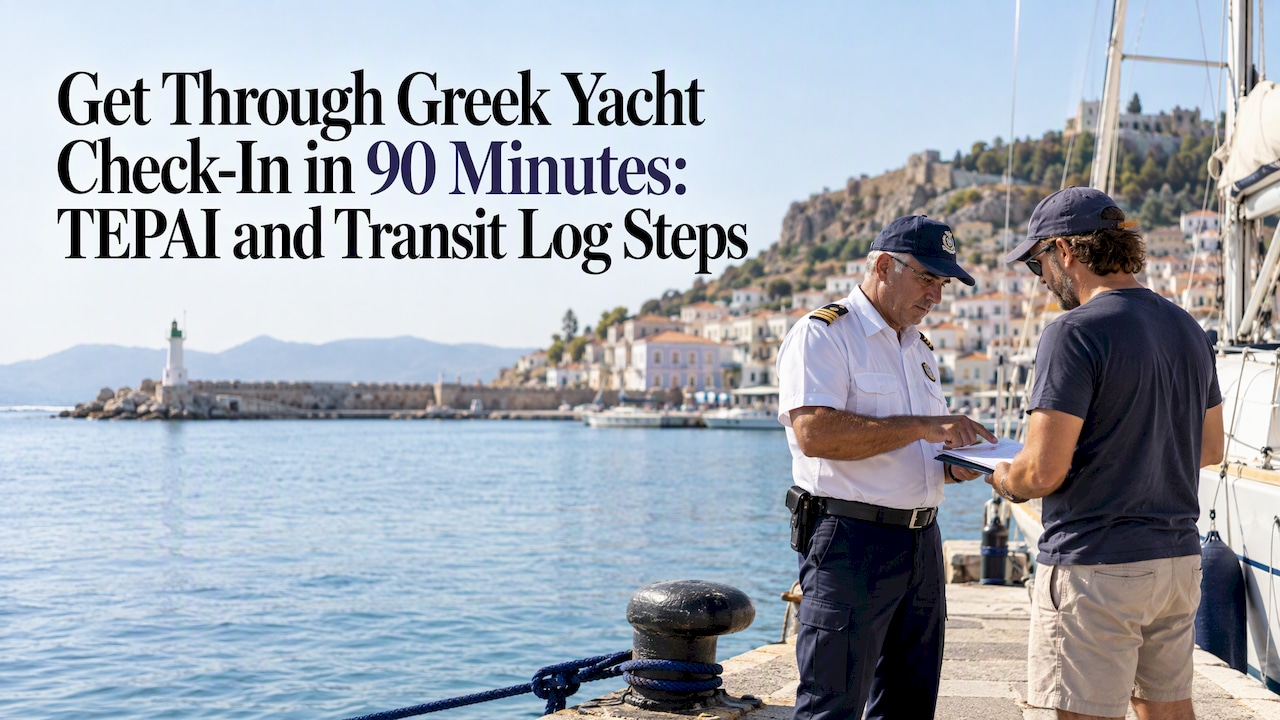
Practical field reports describe a complete check-in taking as little as 90 minutes in a well-prepared Corfu arrival, but busier ports in peak season, or offices with a single staff member handling several boats, can stretch that considerably. Expect longer waits in July and August.
Pro Tip: Submit a partial Transit Log application online before you even reach port. Showing officers a printed copy of that attempt demonstrates good faith and often shortens your interview.
TEPAI / eTEPAI: how the recreational fee works and how to pay it
The TEPAI fee, formally the Recreational and Daily Tour Cruise Ships Fee, applies to private and professional leisure vessels over 7 meters in Greek waters, regardless of flag. If your boat clears that length, you owe this fee before you can clear in.
Payment runs through the myAADE eTEPAI application, which generates a 25-digit e-Paravolo code used to pay via internet banking, post office, or, in certain cases, directly at the Port Authority or Customs for non-EU privately flagged boats where electronic issuance fails.
- Payment is due before or on your date of entry, and again before each subsequent month of stay.
- Vessels over 12 meters that qualify may apply for a yearly lump-sum option instead of paying monthly.
- Take a screenshot of your payment code and receipt the moment you generate it.
- Carry a printed copy as backup in case your phone battery dies or signal drops at the port.
If the eTEPAI portal fails to load, which does happen at smaller islands with weak connectivity, ask the Port Authority or Customs office directly. They can process payment in person for non-EU flagged boats when the online route is not possible.
Transit Log and proof of VAT / Union status: expectations and practical evidence
A Transit Log is required for non-EU flagged yachts entering Greek waters, and it is where VAT status questions tend to surface. EU guidance confirms that temporary admission generally allows a non-EU pleasure craft to remain in the bloc for up to about 18 months, though procedures and checks vary by member state.
Customs officers increasingly want to see formal proof of Union status, not just an invoice.
- An official Customs document carrying an MRN or a T2L/T2LF is the strongest evidence you can present.
- Recent reports note that Greek Customs are enforcing these checks more strictly, and boats without an MRN often receive only a short-term Transit Log, sometimes limited to around 30 days, until formal proof arrives.
- If you only have purchase invoices or informal paperwork, expect officer discretion rather than an automatic refusal.
- When you leave Greek waters, return your Transit Log and keep every stamped crew list; you will need the paper trail again on your next entry.
Common problems and practical avoidance strategies
Not every Greek port handles arrivals the same way, and knowing that in advance saves real time.
- Some ports, including Corfu, Cefalonia, Leros, and Kalimnos, see frequent yacht traffic and tend to move efficiently; research your intended port of entry before you commit to it.
- Bring both digital and printed copies of every document, and keep a charged device on hand specifically for eTEPAI or Transit Log submissions.
- When your VAT status is unclear or your cruising itinerary crosses several jurisdictions, a local clearance agent often costs far less than the hours you would lose sorting it out yourself.
- A simple phrase helps at every office: tell staff you are a “private yacht checking in.” It signals exactly what you need and speeds up the interaction.
Pro Tip: Keep a one-page summary of your boat’s registration number, flag, and VAT status translated into Greek. Handing it over saves the officer from typing out foreign characters and speeds up your paperwork.
SailArmada’s on-the-water checklist and handover priorities
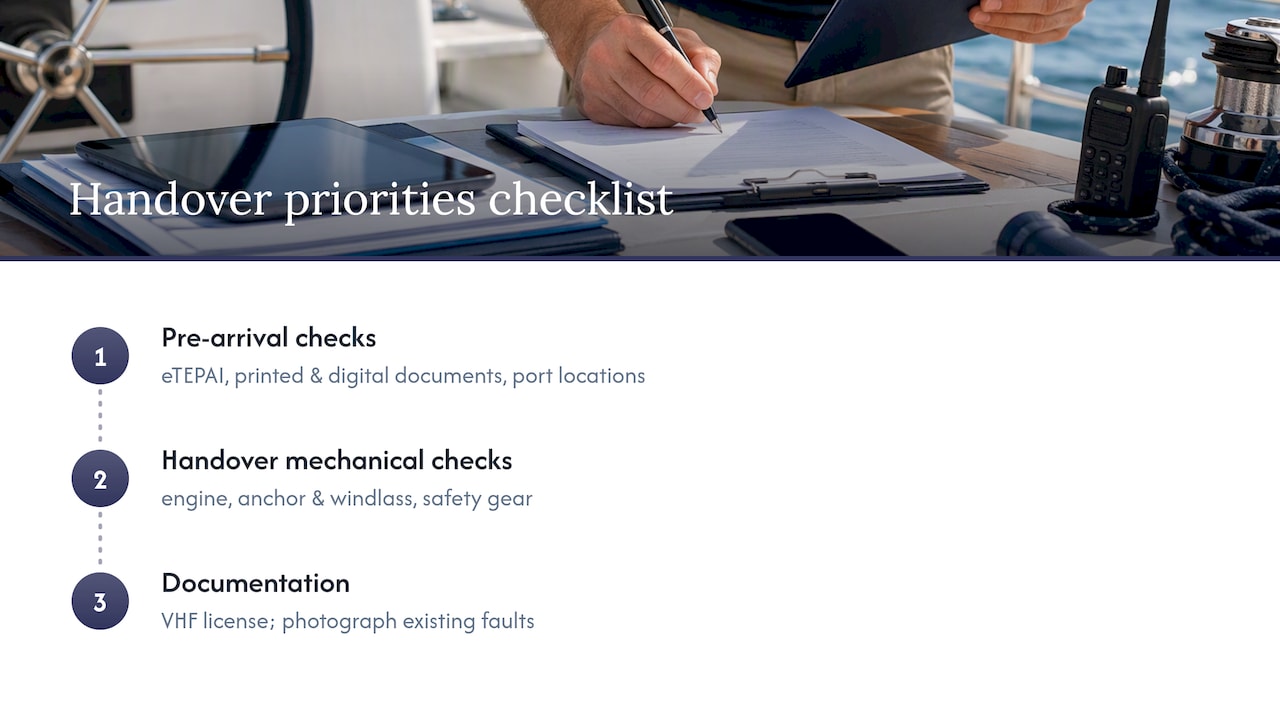
Before any arrival, we confirm eTEPAI status, gather printed and digital documents, and share port office locations with everyone on board so nobody is searching for the harbor master’s office at the last minute.
During handover, priority is given to checking the engine, anchor and windlass, safety gear, and the VHF radio license, documenting and photographing any existing faults before departure to avoid disputes later. The same discipline applies to technical handovers across the Mediterranean: a thorough check at the start protects your whole week.
For guests joining skippered charters, this groundwork happens before boarding—the skipper manages the paperwork so time is spent sailing, not standing in a customs line; see our complete charter guide for more details. The skipper manages the paperwork so time is spent sailing, not standing in a customs line.
Health and safety checks or COVID-19 related entry requirements
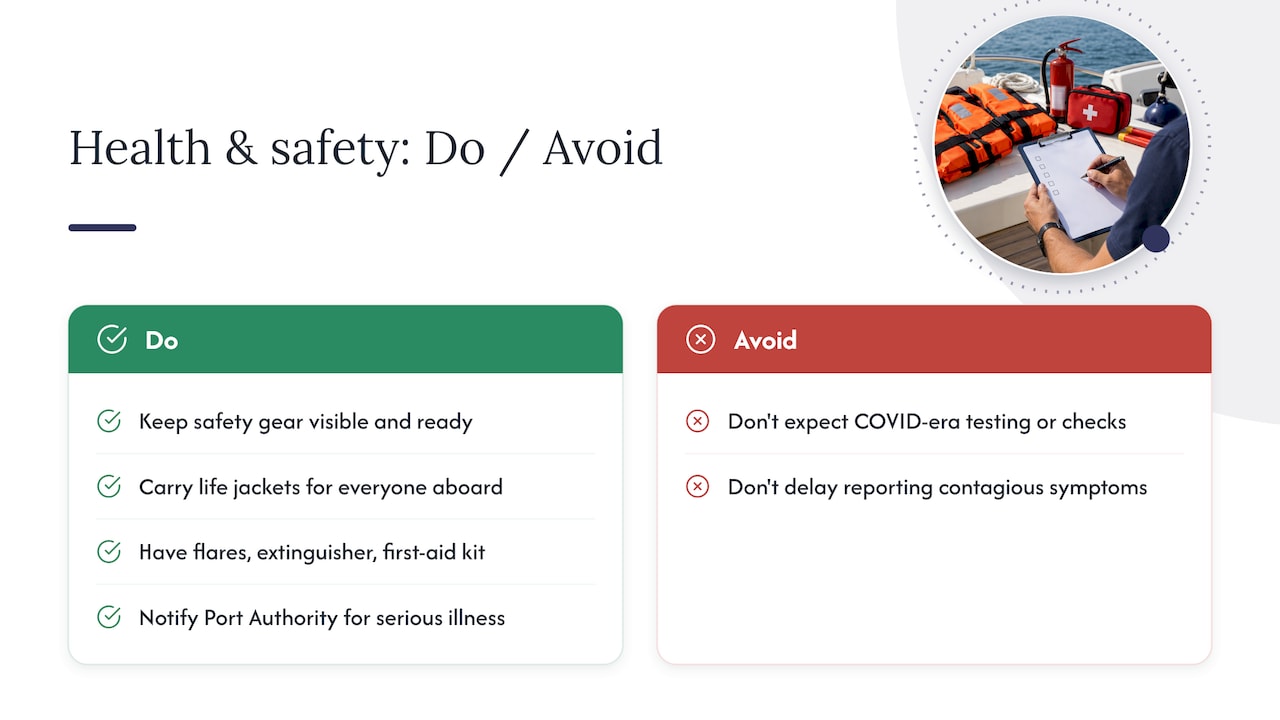
Greece has lifted its COVID-era maritime entry restrictions, and arriving yachts no longer face mandatory testing, vaccination checks, or health declarations tied specifically to the pandemic. Standard port health protocols still apply in principle, meaning officials retain the authority to ask about recent illness aboard, but this rarely comes up for routine charter or private arrivals.
Basic maritime safety checks remain part of a normal inspection. Port Authority or Coast Guard officers can ask to see your safety equipment, including life jackets for everyone aboard, flares, a fire extinguisher, and a first aid kit, at any point during your stay, not only at check-in. Keeping this gear visible and easy to produce saves time if an officer boards for a spot check.
If anyone aboard falls seriously ill or you suspect a contagious condition, standard practice is to notify the Port Authority on arrival rather than wait for an inspection. This is a matter of basic maritime courtesy and safety protocol rather than a formal quarantine trigger, and it rarely results in more than a brief conversation with officials.
Environmental regulations and inspections during check-in
Greek waters, particularly around marine parks and protected islands, carry environmental rules that officials may reference during check-in or later inspections. Discharge of waste water, fuel, or garbage directly into the sea is prohibited, and yachts are expected to use port facilities or holding tanks rather than dumping at anchor.
Anchoring is restricted in some protected zones, especially near seagrass meadows and marine reserves, where damage from anchor chains has become a growing concern across the Aegean and Ionian. Charts and local port notices usually flag these zones, and it is worth checking them before you plan an anchorage rather than discovering a restriction once you arrive.
Officials do not typically run a dedicated environmental inspection at the check-in desk, but failure to comply with waste or anchoring rules can surface during a routine Coast Guard boarding later in your trip. Carrying proof that your holding tank and bilge systems are in working order, and simply avoiding protected anchorages, keeps this a non-issue.
Rules for customs clearance related to personal belongings and provisions on board
Standard personal effects, clothing, equipment, and reasonable quantities of food and drink for the crew’s own consumption generally clear without issue during check-in. Customs is primarily focused on your Transit Log, VAT status, and TEPAI payment rather than itemizing your fridge.
Problems tend to arise with alcohol, tobacco, or goods in quantities that suggest resale rather than personal use. If you are provisioning heavily before a long cruise, keep receipts, particularly for duty-free purchases made outside the EU, in case an officer asks about quantities that look unusual for your crew size.
Firearms, flare guns beyond standard safety allowances, and certain drone equipment can draw extra scrutiny and sometimes require separate declarations. If your inventory includes anything outside typical sailing gear, it is worth asking your charter company or a local agent in advance rather than finding out at the customs desk.
Specific regulations regarding charter yachts vs privately owned yachts
Charter yachts and privately owned yachts both go through the same basic check-in sequence: Port Authority, Customs and Immigration, and Transit Log, but the paperwork expected differs. Charter vessels typically need to show a valid charter license, commercial registration, and proof of professional skipper qualifications in addition to the standard crew list and insurance.
Privately owned yachts face more scrutiny around VAT and Union status, since a private owner bears personal responsibility for proving the boat’s tax status within the EU. A chartered yacht operating under a Greek or EU-based charter company typically has this resolved at the fleet level, which is one reason many owners without EU VAT documentation opt for a managed charter rather than independent cruising.
Crew lists for charter yachts also usually separate paying guests from working crew, which matters for both customs and insurance purposes. If you are unsure which category applies to your trip, our overview of chartering in Greece covers how private and skippered arrangements differ in practice.
Information on quarantine rules if applicable
Greece does not currently impose a standard quarantine period for arriving yachts or crew. The pandemic-era isolation requirements that once applied to maritime arrivals have been lifted, and a routine check-in does not trigger any mandatory waiting period before you can go ashore or continue cruising.
The exception is a genuine public health concern, such as a confirmed infectious illness aboard, in which case the Port Authority or local health office retains discretion to request isolation measures on a case-by-case basis. This is uncommon and not something the average charter or private arrival needs to plan around.
If you are arriving from outside the EU and carrying live animals, separate veterinary and quarantine rules apply through Greek agricultural authorities, and these are handled independently of your yacht check-in process. Pet owners should confirm requirements with Greek veterinary services well before departure rather than assuming the Port Authority will handle it.
Information on registering your yacht’s local mooring or anchorage permissions
Greece does not require a separate national mooring registration for every anchorage, but marinas and organized moorings do require individual booking or check-in with the local harbor master, separate from your Transit Log process. Expect to pay a berthing fee set by each marina, which varies by location and season.
Free anchoring in open water remains widely available around the Greek islands and does not require prior permission in most cases, aside from the protected zones covered earlier. Popular bays can fill quickly in peak season, so arriving early in the afternoon rather than at dusk gives you a better shot at a secure spot.
Marina fees and availability differ enough between islands that it is worth checking expectations before you commit to a route; our breakdown of marina costs around Greece gives a practical sense of what you are likely to pay at different stops.
First-person perspective: why a fast, correct check-in protects your trip
We have found that thorough documentation and patience at check-in, not speed, is what actually protects your itinerary. Skippers who treat the paperwork as the first real task of the trip, rather than an obstacle to rush past, avoid the fines and detours that eat into everyone’s week.
— Sail
How SailArmada can simplify arrival and charter logistics in Greece
Handling Greek check-in alone means juggling eTEPAI codes, Transit Log portals, and VAT paperwork while your crew waits on deck. The Greece private sailing holidays include a professionally trained skipper who manages the Port Authority, Customs, and Transit Log steps while you focus on the islands ahead.
- Private and group sailing holidays with curated routes across the Greek islands.
- Skippers who assist with port formalities, document checks, and arrival logistics.
- Transparent pricing and detailed boat options, with support available at every stage of your trip.
Our Greece – Go Private holidays start from 560 € per week per person. Check available dates and routes to get your crew on the water without the paperwork headache.
FAQ
What is the 10 rule for yachts?
There is no universal rule recognized in Greek maritime or customs regulation for yacht check-in. If you encountered this term elsewhere, it likely refers to a different regulatory context and is not part of the official Greek arrival process covered by AADE or Port Authority procedures.
What is the 12 person rule on a yacht?
Passenger limits on a yacht depend on the vessel’s safety certification and flag state rules rather than a single fixed “12 person” standard across Greece. Your boat’s registration documents and safety certificate specify the maximum number of people allowed aboard, and that figure is what Port Authority and Customs check during clearance.
How much does it cost to keep a yacht in Greece?
Costs vary by marina, vessel size, and season, and include berthing fees, the TEPAI fee for vessels over 7 meters, and insurance. Our guide to marina fees in Greece breaks down what owners typically budget for mooring across different islands.
How to avoid VAT on boats?
Avoiding VAT legally generally means qualifying for temporary admission as a non-EU flagged vessel, which allows you to remain in EU waters for up to about 18 months under EU guidance without paying EU VAT, provided you can prove non-EU ownership and use. For EU-owned or EU-based vessels, VAT is typically already due, and attempting to sidestep it without proper documentation risks fines or a restricted short-term Transit Log at your next Greek port.
Sources
- eTEPAI | ΑΑΔΕ
- Guidance on pleasure craft (European Commission)
- Cruising Greece: What to watch out for in 2025
- Checking in to Greece? Here’s a Simple Guide – Farfelu